Analyzing how the excess or reduction of inventories in large United States chains generates invaluable opportunities for wholesale buyers and distributors in the USA is the key to modern commercial success. In this article, we unravel the recent financial reports of giants like Walmart and Target to show you how their stock adjustment strategies flood the secondary market with premium merchandise. Discover the direct relationship between Wall Street reports and your profitability, and how partnering with Go Liquidator allows you to capitalize on these corporate movements to multiply your profits.
Often, when the media talks about Wall Street, the stock market, or the quarterly reports of megacorporations, the average merchant in the USA changes the channel or turns the page. They think: “That is macroeconomics for bankers, it has nothing to do with my store or my warehouse.”
Today, we are going to completely destroy that myth.
In the fascinating world of imports and reverse logistics, information is power, and the quarterly reports of giants like Walmart, Target, and Costco are, literally, the treasure map to your next big deal. The financial movements of these corporations determine exactly which products, in what quantities, and at what prices will arrive at our Go Liquidator warehouses in Miami.
Today we will teach you to read between the lines. We are going to analyze, with data updated to this midpoint of 2026, what corporate phrases like “inventory optimization” or “margin reduction due to overstock” really mean, and how these macroeconomic phenomena translate into the greatest era of abundance and profitability for you as a wholesale buyer in the USA. Get ready to think like a true retail magnate!
1. The secret language of Wall Street: translating quarterly reports
By the middle of this year 2026, the largest public companies in the retail sector have presented their second-quarter (Q2) financial results. When Chief Executive Officers (CEOs) sit down to talk to investors, they use very particular language to explain why their warehouses are full or why their primary profits were slightly affected.
They often use terms like “right-sizing inventory” or “aggressive markdown strategies.” For the traditional investor, this might sound like caution. But for the liquidation industry, this is music to our ears.
When a chain like Target reports that it has managed to reduce its inventory levels by 15% compared to the previous year to make room for the new season’s merchandise, a monumental logistical question arises: Where did that 15% of massive merchandise physically go?
It didn’t evaporate. That gigantic volume of clothing, electronics, toys, and home goods was packed onto pallets and sold through the B2B (Business to Business) market to master distributors like Go Liquidator. The financial report is simply the public announcement that top-quality merchandise has just been released to the secondary market at ridiculously low prices.
2. Excess or reduction: two sides of the same golden coin
For the liquidation market, both excess inventory and its intentional reduction in large chains generate scenarios of extremely high profitability for your business in the USA. Let’s analyze both situations:
- The Excess Scenario (Overstock): Sometimes, retail giants miscalculate demand. They import millions of units of an appliance or a fashion line expecting record sales, but a change in weather or consumer trends leaves shelves full. Bloomberg quarterly reports reflect this as “stagnant inventory.” To avoid paying sky-high storage costs, chains decide to liquidate the intact merchandise, in its original packaging, just weeks after its launch. The result for you: You buy completely new and trendy products (Shelf Pulls) for a fraction of their manufacturing cost.
- The Strategic Reduction Scenario: Other times, companies like Walmart implement extreme efficiency strategies. They decide to clean up their balance sheets by closing product lines that do not rotate in 30 days, prioritizing only ultra-fast consumer items (like groceries). In doing so, they expel millions of durable items (like TVs, furniture, and tools) into the secondary market. The result for you: You have access to a constant flow of durable merchandise from global brands, ideal for stocking your physical store or e-commerce channels.
To give analytical weight to this phenomenon, Jennifer Bartashus, renowned Senior Retail Analyst for Bloomberg Intelligence, masterfully details this dynamic in the current context:
“When major retailers talk about ‘inventory rationalization’ on their earnings calls, what the market should interpret is a massive injection of liquidity and merchandise into the secondary market. Fortune 500 corporations prefer to take an immediate accounting loss through B2B liquidation rather than paralyze their supply chain. This mechanism has turned reverse logistics into the true hidden engine of cross-border commerce.”
The 3 major global macroeconomic trends of 2026 driving the biggest wave in the market
3. The opportunity graph: correlation between adjustments and abundance
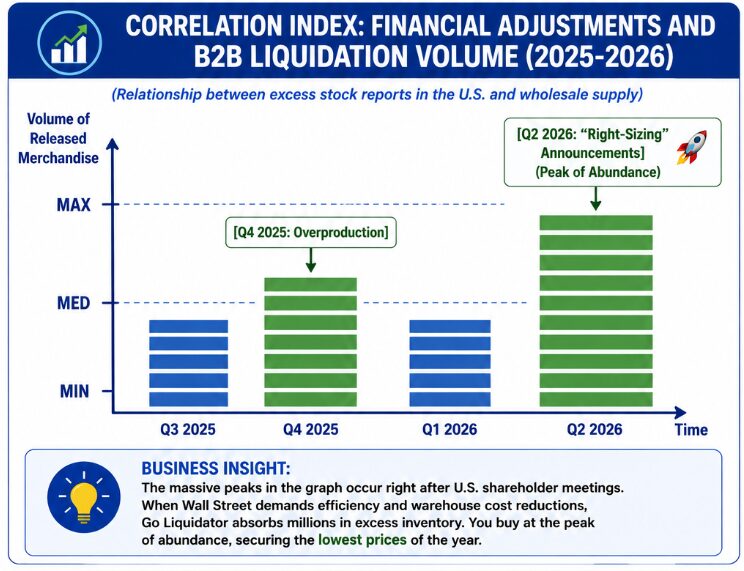
To visualize how the financial movements of U.S. giants impact your supply and prices, our analytics team has developed the following correlation graph. Observe how, every time companies announce “balance sheet cleanups,” the volume of premium lots at Go Liquidator skyrockets:
4. The bridge to the USA: your unfair strategic advantage
Understanding these macroeconomic movements gives you a privileged perspective, but theory without action does not generate money. This is where Go Liquidator’s infrastructure comes into play to transform this Wall Street dynamic into cold, hard cash for your pocket in the USA.
The merchandise that large chains massively liquidate cannot be absorbed by small merchants in the United States; it requires a player with industrial capacity, colossal warehouse space in Miami, and the liquidity to buy hundreds of trucks in a single day. By acting as that macro-buyer, we create the perfect bridge for you.
Siddharth Cavale, specialized retail and consumer correspondent for Reuters, provides a brilliant perspective on how this dynamic benefits emerging markets and international distributors:
“The excess stock that punishes operating margins in the primary US market automatically becomes the main growth driver for wholesale distributors in regions like the USA. These geographies act as highly valuable absorption markets, where American brands maintain enormous prestige and liquidated merchandise is sold with profit margins far superior to those of the original manufacturer itself.”
This is your unfair strategic advantage over your local competition:
- Price Arbitrage: Your competition buys from traditional distributors who import from Asia, paying exorbitant freight and standard factory prices. You, by leveraging Go Liquidator, acquire liquidated merchandise below the corporation’s manufacturing cost.
- Unsurpassed Quality: You are not buying “leftovers of dubious origin”; you are buying exactly the same products that were in the aisles of Target or Costco just weeks ago.
- Turnover Speed: By buying at pennies on the dollar, you have enough margin to offer unbeatable discounts in your country. Your shelves will empty at a speed that will amaze your competitors, and your cash flow will grow exponentially.
How liquidations became one of the most profitable environmental solution on the planet
Turn financial news into your wealth engine
From today on, every time you read in the news that a major US retailer has reported excess inventory or is cleaning out its warehouses, do not see a corporate problem; see a shipment of opportunities heading straight towards you.
The financial results of retail giants are not just numbers on a screen; they are the pulse that dictates the abundance of our B2B supply. At Go Liquidator, we tirelessly monitor these market movements to always secure the best lots, the most desired brands, and the most lucrative contracts, all with a single goal: to place that wealth entirely at your disposal.
References:
Bartashus, J. (2026, July). | Cavale, S. (2026, July). | Target Corporation. (2026). | Walmart Inc. (2026).
