For the traditional retail merchant, trapped in the rigid retail schemes of the last century, these changes may seem like an indecipherable puzzle or, even worse, a threat to their profit margins. However, for the community of strategists we build at Go Liquidator, this landscape is not a reason for uncertainty; it is the announcement of an era of unprecedented abundance.
The crises of some are the gold mines of others, and today we are going to reveal how three global macro trends in this 2026 are acting as the definitive propellers of the liquidation industry. Get ready to discover, with real, updated, and verified economic data, why partnering with Go Liquidator today positions you at the top of the commercial food chain in your region. Join us in deciphering the forces that will multiply your capital!
1. The boom of nearshoring and logistical stabilization in the axis of the americas
During the first half of this decade, over-reliance on extended supply chains to Asia wreaked havoc on inventories worldwide. Transoceanic tariff fluctuations, delays in shipping channels, and the volatile cost of maritime containers forced the great titans of U.S. retail to make a radical shift toward Nearshoring (bringing production and distribution closer to geographical proximity).
In 2026, Fortune 500 corporations like Amazon, Walmart, and Target have massively consolidated their distribution centers at strategic points in the United States. By having inventories closer to their end consumer, the speed of e-commerce has accelerated, but this has brought a direct mathematical consequence: the volume of warehouse surplus (overstock) and merchandise returns has reached historic highs on U.S. soil.
This trend consolidates a perfect mutually beneficial ecosystem. Brands urgently need to free up physical space in their North American warehouses. By partnering with Go Liquidator, they find a massive partner capable of absorbing those industrial volumes and channeling them ethically.
For you, the advantage is colossal: your inventory is already on the continent. By buying our pallets in Miami, you acquire merchandise from global brands that has already cleared primary customs and is nationalized in the U.S. You free yourself from Asian uncertainty. Your logistics become fast, predictable, and affordable, allowing you to restock your local business in a matter of days or hours by air, or in a couple of weeks by sea. While your competition suffers waiting for ships that take months, you keep your shelves stocked and your cash flow spinning at maximum speed.
2. The “Discount Effect” on global consumer psychology (Off-Price Shopping)
The second major trend this year is not at the ports, but in the minds of your customers. The global inflationary adjustments of recent years have changed consumer habits forever, definitively giving rise to the era of the Smart Consumer.
According to corporate reports consolidated in the first half of 2026 by firms like McKinsey & Company, retail shopping behavior has experienced irreversible polarization. Traditional department stores selling at inflated prices (full-price) are losing traffic at an accelerated rate. In contrast, the off-price sector (heavily discounted sales of premium brands) is the fastest-growing in global commerce.
The modern consumer has discovered that paying the highest price in an ostentatious mall is no longer synonymous with status; now, true prestige lies in finding that same designer garment, that same smart appliance with connectivity, or that premium professional tool, but at a 40%, 50%, or 60% discount.
By buying your lots and pallets with us, you become the official channel to satisfy this massive demand in your country. Because Go Liquidator acquires these surpluses and e-commerce returns for pennies on the dollar due to the urgent space needs of major brands, we transfer that laughable acquisition cost to you.
You have the widest financial maneuvering margin in the market: you can offer your local community the American brands they love with spectacular discounts that crush any traditional competitor, and still secure net profits exceeding 100% or 200% for your company. The global context has turned your liquidation business into a counter-cyclical necessity: the smarter the consumer gets, the more your store sells.
Which Economic News Should You Read to Multiply Your Profits in Liquidations
3. The institutionalization of ESG laws and the mandatory circular economy
What started as a voluntary corporate social responsibility initiative is now, in 2026, an unavoidable law. Governments and international financial committees have drastically tightened ESG (Environmental, Social, and Governance) regulations. Currently, major U.S. retail chains are prohibited by law from destroying, burning, or dumping in landfills the merchandise they fail to sell during the season or receive as digital returns.
Inventory destruction now carries severe financial penalties and incalculable reputational damage in the eyes of a public demanding sustainability. The only legally, financially, and ethically viable way out for these mega-corporations is to channel 100% of their surplus into the secondary market through the Circular Economy.
The Graph of Sustainable Abundance
To measure the impact of this trend, our financial analysis team has projected how ESG regulatory pressure has skyrocketed the injection of premium inventory from U.S. retail into the B2B liquidation market in recent years:
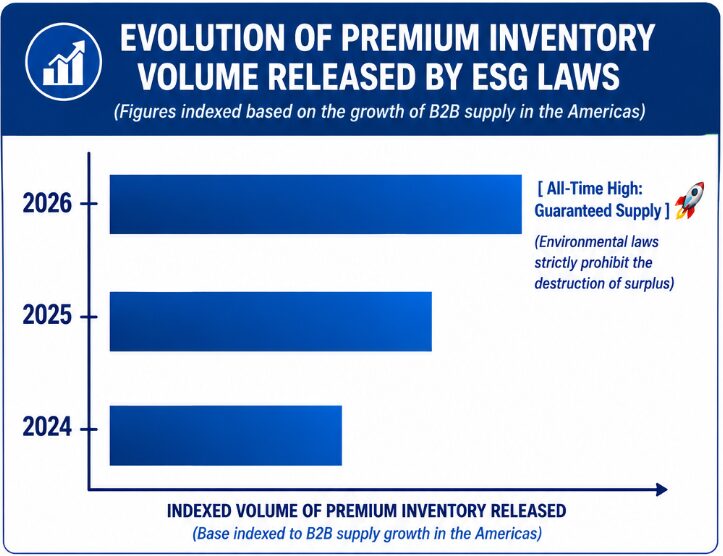 Source: Projections based on waste diversion metrics from the Reverse Logistics Association (RLA), 2026.
This macro trend acts as a perpetual guarantee for your supply. The “pipeline” of high-quality merchandise will never close; on the contrary, it flows stronger every day. Go Liquidator consolidates itself as the great receiver of this green wave, signing exclusive contracts with retail giants that need to clean up their balance sheets under ecological standards.
By buying these pallets from us, your business is no longer seen simply as a discount store; you elevate yourself before your community as a Hub for Sustainable Consumption. You can use the Circular Economy as a powerful and modern marketing argument on your social media. Your customers will feel proud to buy from you, knowing they are saving money while simultaneously preventing environmental waste by giving a second useful life to immaculate products.
Your Strategy for Success in the 2026 Window of Opportunity
As a visionary entrepreneur, you must know that great fortunes are not built by chasing the past, but by surfing the waves of the present into the future. Nearshoring has concentrated inventory in the U.S., consumer psychology demands smart prices, and ESG laws force multinationals to liquidate at accelerated rates. All the stars of the global economy have aligned in favor of B2B liquidations.
At Go Liquidator, we have designed our entire corporate infrastructure precisely so you can get the most out of these three trends:
- Strategic Location: We are located at the strategic point of Miami, the perfect logistical gateway to shorten the distances of nearshoring to the USA.
- Multilingual Support: We have a team providing multilingual support (Spanish, English, French, Portuguese, and Arabic) to serve you in a personalized and human way, adapting to the specific needs of your local market.
- Space Optimization: We take care of maximizing volume and optimizing your containers, filling them ourselves with professional stowing techniques so you save every last penny on transportation costs, turning logistical efficiency into pure profit for your pocket.
- Total Transparency: We guarantee proper handling of the merchandise and provide clear, detailed manifests based on data, eliminating surprises and transforming every pallet into a safe and predictable investment.
5 Reasons why Go Liquidator is your unique ally in global commerce
The world is changing in your favor, the supply of original and nationalized American brands is ready in our warehouses, and the demand in your country is stronger than ever. The only thing missing to activate this machinery of prosperity is your decision to lead. Contact us!
References
McKinsey & Company. (2026). | Reverse Logistics Association (RLA). (2026). | Supply Chain Management Review. (2026).
Frequently Asked Questions
Why do global economic disruptions create opportunities in the liquidation industry?
Economic disruptions often leave manufacturers, retailers, and importers with excess, returned, or unsold inventory. Rather than storing or disposing of these products, businesses sell them through liquidation channels at significantly reduced prices. This allows buyers to access branded merchandise with higher profit margins while helping sellers recover capital and optimize inventory turnover.
How can businesses benefit from the 2026 macroeconomic environment?
Businesses can benefit by adapting their sourcing strategies to capitalize on increased availability of liquidation inventory. Purchasing overstock, shelf pulls, and customer returns from established liquidation suppliers enables companies to diversify their product offerings, reduce procurement costs, react more quickly to market demand, and strengthen profitability despite ongoing global economic uncertainty.
