One of the most frequent questions we receive from entrepreneurs just discovering this gold mine is: “If a major brand—like a renowned department store or an e-commerce giant—has new products in perfect condition, why don’t they just keep them in their massive warehouses until next year to sell them at full price? Why do they prefer to sell them off at liquidation prices?”
To the intuition of a traditional consumer, keeping things seems like the most logical option. However, in the financial mathematics of high-level corporate circles, storing stagnant merchandise is one of the biggest mistakes a company can make. Today, with our characteristic optimism and clarity, we are going to break down the exact reasons why corporations prefer, need, and love to liquidate their inventory.
Most importantly: we will discover why this brilliant financial decision by multinationals is, quite literally, the key that opens the door to your commercial success.
1. The Invisible Enemy: Inventory Carrying Cost
To understand why a major chain doesn’t simply “keep” its products, we must introduce a vital concept in international logistics: Inventory Carrying Cost.
Having a shoebox, a blender, or a lot of winter jackets taking up space in a distribution center is not free. In fact, it is extremely expensive. Companies must pay for warehouse square footage, electricity, climate control, security personnel, fire and theft insurance, and taxes on those goods.
According to the most recent reports (2026) from the Council of Supply Chain Management Professionals (CSCMP) and market intelligence firms, the annual cost of maintaining immobilized inventory can represent up to 30% of the total value of the merchandise.
To visualize this financial impact that scares corporate directors (and benefits you), we have prepared the following graph based on real data from the logistics industry:
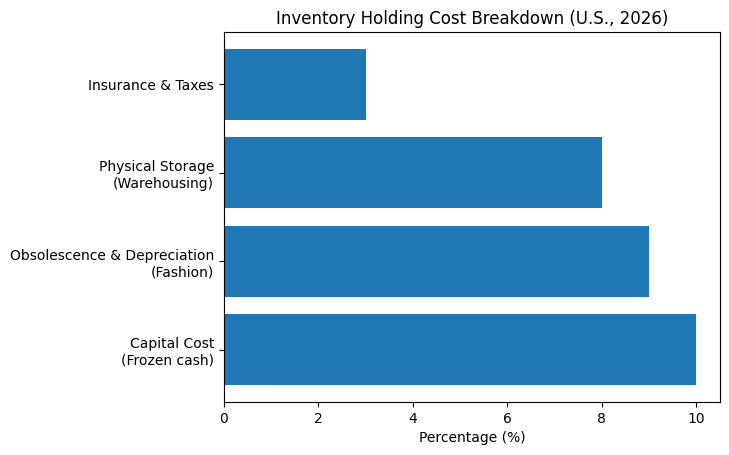 Source: Go Liquidator internal report based on data from the Council of Supply Chain Management Professionals – CSCMP, 2026 Logistics Report
The lesson is clear: If a brand stores $1 million in coats for a year, it will lose approximately $300,000 just in maintenance costs. Financially, it is infinitely smarter to sell that merchandise today to a wholesale distributor like Go Liquidator at a steep discount than to bleed money paying for its storage.
Turn economic information into profits! Understanding these corporate movements is the first step to buying smart. We invite you to read our expert guide: Which economic news should interest any liquidation buyer to discover what other market signals indicate the perfect time to buy.
2. The Law of Retail Gravity: Space is Limited
In retail, physical space is king. Major chains in the United States operate under extremely rigid calendars. When February ends, stores and their distribution centers must be ready to receive the spring collection. If shelves or back warehouses are still full of last season’s sweaters, the new spring products (which are the ones that will leave the highest profit margin at that time) will have nowhere to be displayed or stored.
Storage space (shelf space and warehouse space) has a physical limit. Liquidation acts as a vital escape valve. By selling entire containers of surplus to Go Liquidator, brands free up millions of cubic meters of space in a matter of hours.
For you, as a business owner, this means our supply is constant. Seasons change, calendars move forward, and we receive that premium inventory uninterruptedly so that you never run out of attractive merchandise to offer.
3. Capital Velocity: Money Today vs. Boxes Tomorrow
Successful companies are measured not just by the amount of physical assets they own, but by their cash flow (liquidity). Having millions of dollars trapped in old inventory is like having money buried in the garden: it generates no return and cannot be used to grow the company.
When a department store chain or an e-commerce giant decides to liquidate a massive surplus, their number one goal is to recover capital immediately. Even if they recover only a fraction of the original retail value, that cash entering their bank accounts today is pure gold. They use it to pay payroll, invest in new technologies, or finance the production of the collection that will be next year’s hit.
This corporate need to recover rapid liquidity is exactly what allows you to acquire high-quality lots for pennies on the dollar.
Learn how industry giants act! Discover The product lines with the highest turnover in the liquidation market.
4. Obsolescence and the Danger of Going Out of Style
We live in an era of immediacy. Technology advances in months, and fashion trends change in weeks.
If a tech brand decides to keep a headphone model in a warehouse because it didn’t sell enough this quarter, by next year that model will be obsolete because they will have launched the next generation. The product, which is perfectly functional and valuable today, will be worth zero tomorrow. The same happens with fashion: the color that is trending today might not be in six months.
Liquidating inventory quickly allows products to reach the secondary market while they still possess high commercial value. And this is where you work your magic. Trend curves tend to be longer and more stable. That product that just left the main display window in New York or Los Angeles is exactly what your customers in Colombia, Chile, Mexico, or Peru are enthusiastically looking for today.
5. Sustainability and Circular Economy: Destroying is No Longer an Option
For a long time, there was a dark side to the industry: some ultra-luxury brands preferred to destroy (incinerate or shred) their surpluses rather than sell them at a discount, out of an irrational fear of “damaging their prestige.”
Fortunately, the world of 2026 is very different. Strong government regulations against commercial waste, combined with immense pressure from modern consumers demanding eco-friendly practices, have made the destruction of new inventory unacceptable and, in many cases, illegal.
The only ethical, sustainable, and financially responsible way out for brands is to introduce their surpluses into the Circular Economy through the liquidation market. By selling their lots to Go Liquidator, brands meet their corporate sustainability goals and protect the environment.
Your Privileged Position in the Ecosystem
As you can see, inventory liquidation is not a sign of corporate failure; it is the smartest, most necessary, and vital gear of modern retail. It prevents massive storage losses, injects fresh capital into brands, frees up space for innovation, and protects the planet from waste.
But of all the players in this immense global chain, you are the one who gets the best part.
Thanks to this ecosystem, you no longer need to travel to China or deal with expensive and slow Asian freight to get good prices. The best brands in the world are handing over their premium products to you through Go Liquidator. They give you the opportunity to offer undeniable quality to your community while you enjoy expansive profit margins that will protect and grow your capital.
Today’s consumer, more educated and conscious than ever, is looking for exactly what you have to offer.
The market is full of abundance for those who know where to look. At Go Liquidator, our warehouses in Miami are in constant motion, receiving trucks full of these wise corporate decisions, ready to be packed into strategic pallets that will drive your business.
Are you ready to stop worrying about high traditional import costs and start capitalizing on the best-kept secret of retail giants?
Our team of commercial advisors awaits you on WhatsApp and across all our official channels to show you this week’s fresh inventory. Visit our portal to contact us, keep learning, and discover the merchandise that will transform the future of your company. Let’s multiply your sales!
Sources: Association for Supply Chain Management (ASCM). (2026) | Council of Supply Chain Management Professionals (CSCMP). (2026) | Forbes Business Council. (2025).
Frequently Asked Questions
What types of inventory do retailers typically liquidate?
Retailers commonly liquidate overstock items, customer returns, shelf pulls, seasonal merchandise, discontinued products, and excess inventory. These products are then made available to wholesalers and resellers at discounted prices.
How does retail inventory liquidation benefit resellers?
Inventory liquidation gives resellers access to branded merchandise at below-retail prices, allowing them to increase profit margins and expand their product selection. At the same time, retailers improve inventory efficiency while buyers gain valuable sourcing opportunities.
