Today we are going to break down the three leading industries generating liquidation inventory in 2026. We will analyze why their internal dynamics (such as the speed of fashion, technological evolution, and digital returns) play in your favor. We will discover how this immense stock availability creates a perfect mutually beneficial (Win-Win) ecosystem between your company and Go Liquidator, and we will give you the master tactics to squeeze the maximum profit margin out of every lot. Get ready to rewrite the financial future of your business!
1. The X-Ray of Global Supply: Where Does the Abundance Come From?
For a business to be predictable and scalable in the long term, it cannot rely on random or scarce inventory sources. You need the certainty that the supply pipeline will never close. In the universe of liquidations and reverse logistics, that certainty is backed by strong macroeconomic data.
Throughout this year, the volumes of merchandise diverted to the secondary market have reached historic highs on North American soil. But how is this immense industrial pie divided? Which sectors are leading the charge and saturating our warehouses with opportunities?
To answer this question with the scientific precision that characterizes us, our data analytics department has processed the most recent consolidated metrics from the Reverse Logistics Association (RLA) and corporate sustainability reports. Below, we present the visual map of global liquidation volume:
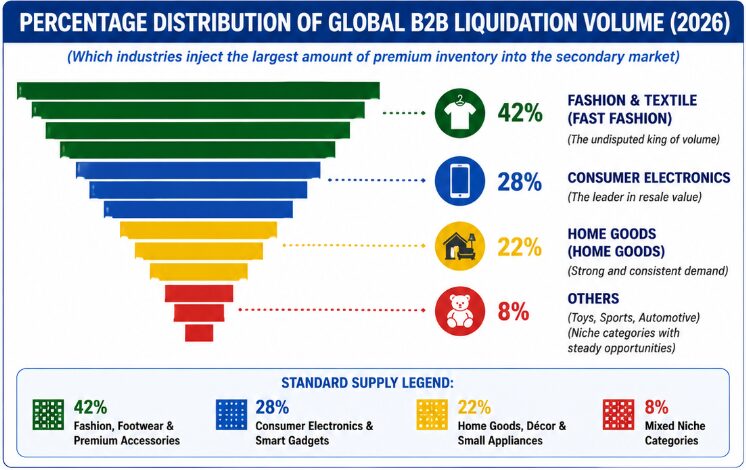 Source: Reverse Logistics Association (RLA), first half of 2026.
As clearly seen in the graph, three major industrial titans represent over 90% of all merchandise available in the liquidation market. Let’s dive into each of them to discover how you can transform them into liquid gold for your company.
2. The 3 Leading Industries and How to Exploit Their Potential
A. The Fashion, Footwear, and Accessories Industry (42% of Volume)
- Why it generates so much inventory: Fashion operates at breakneck speed. The Fast Fashion model and micro-seasons force large retailers like Macy’s or Target to renew their shelf collections almost every 15 days. If a batch of dresses, pants, or brand-name sneakers does not sell within its allotted time window, it becomes an obstacle for the new collection. Additionally, it is the number one category for e-commerce returns due to consumer sizing errors.
- The Mutual Benefit (Win-Win): Textile corporations need to empty their massive distribution centers to comply with environmental regulations and ESG goals that prohibit the destruction of textiles. By selling us these massive lots, Go Liquidator helps them clean up their balance sheets and keep their warehouses green. In turn, we pass on to you immaculate lots of premium clothing with original price tags (Shelf Pulls) for a tiny fraction of their true value.
- Your Golden Strategy: Take advantage of reverse seasonality. Buy the coats, jackets, and branded boots that U.S. stores liquidate at the end of their winter for ridiculously low prices. Store them in your warehouse and resell them in the USA when the rainy season or local cold weather begins. Your margins will exceed 200%!
Read also: Which sectors generate the most liquidations in the world and how to multiply your profits
B. Consumer Electronics and Smart Gadgets (28% of Volume)
- Why it generates so much inventory: Here the driver is not the weather, but constant innovation. Technology lifecycles are extremely short (6 to 12 months). When a new generation of smartwatches, wireless headphones, or home devices is announced, the previous generation is removed from the primary market to protect the brand’s value, becoming available in sealed boxes as Overstock. Likewise, it is a category flooded with “Open-Box” returns, where the customer returned the item simply because they didn’t know how to set it up.
- The Mutual Benefit (Win-Win): The logistical burden of technically inspecting every returned headphone or air fryer is unfeasible for brands. By consolidating these electronic lots and transferring them to our Hub in Miami, we provide them with a fast and massive exit. For your business, this represents the opportunity to acquire technology with cutting-edge microcontrollers and sensors at clearance prices.
- Your Golden Strategy: Electronics are the king of the “High Ticket”. Instead of struggling to sell hundreds of small, low-value items, a single mixed electronics pallet allows you to sell products with high perceived value (such as soundbars, tablets, or robot vacuums). You will serve fewer customers, make fewer local logistical shipments, and recover the entire investment of the pallet by selling just the first few units out of the box.
C. Home Goods and Small Appliances (22% of Volume)
- Why it generates so much inventory: This category encompasses everything from Egyptian cotton sheet sets and designer rugs to professional blenders and high-end cookware sets. The major trigger for liquidation in this sector is physical volume and logistical weight. When a customer returns a compact dining set or a bulky air purifier, the domestic freight cost in the U.S. to return the item to the central factory is often higher than the manufacturing value of the product itself. Department stores prefer to liquidate it locally rather than see their margins devoured by domestic transport.
- The Mutual Benefit (Win-Win): Go Liquidator absorbs these bulky products thanks to our industrial-scale storage capacity. Then, our experts apply professional stowing techniques, placing the dense lots at the base of the container and topping them with the lighter ones so you take advantage of every cubic centimeter and dilute the international freight cost as much as possible. You receive spectacular home products that transform the quality of life for your local customers at crazy prices.
- Your Golden Strategy: Home goods are an aspirational and high-loyalty category. Create “Bundling” (Combo) strategies. If your mixed pallet included a high-end gourmet coffee maker and some fine porcelain cups that are moving slower, do not sell them separately. Bundle them under the concept of a “Home Barista Combo.” The star product will drive the sale of the accessory, accelerating your turnover and leaving your shelves clean for your next import.
3. The Unbeatable Advantage of Partnering With Go Liquidator
Knowing which industries are the richest in opportunities is the treasure map, but you need the right ship to cross the logistical ocean. That is exactly what we are for your company. At Go Liquidator, we have structured our corporate DNA so you can squeeze the most out of these three leading industries:
- Strategic Connection Location: We operate from Miami, Florida, the undisputed logistical gateway that directly, quickly, and economically connects the massive flow of U.S. surplus with customs in the USA.
- Category Flexibility in Your Container: As we explained in our practical guides, you are not forced to marry a single industry. By meeting the purchase minimums for each offer, you can mix fashion, electronics, and home goods in a single container, diversifying your risk and building “a shopping mall on wheels” for your city.
- Multilingual and Human Support: Forget about automated emails or language barriers with Asian suppliers. Our team of sales representatives provides you with expert and personalized advice in Spanish, English, French, Portuguese, and Arabic. We listen to you in your native language, analyze the seasonality of your region, and suggest the exact manifest based on pure data.
- 14-Day Logistical Breather: We safeguard your purchased merchandise for up to two full weeks 100% free of charge at our facilities, giving you the perfect time margin to quote the most economical international freight rates on the market without the pressure of daily storage fines.
Discover the power of our logistical support at Go Liquidator
Take the Definitive Step Towards the Peak of Retail
This year’s global macroeconomic board is set up to reward the audacity of entrepreneurs who leverage reverse logistics. The most powerful industries on the planet are emptying their warehouses at record paces, and all that wealth is concentrated and ready for you at our loading docks in Miami.
Do not let your competition take the electronics, fashion, or home goods manifests that your local customers are craving to buy right this very moment. Take the reins of your business’s financial destiny.
References McKinsey & Company. (2026). | National Retail Federation (NRF). (2026). | Reverse Logistics Association (RLA). (2026).
Frequently Asked Questions
Why do electronics, fashion, and home goods end up in liquidation?
Major retailers and brands constantly introduce new collections, product updates, and seasonal inventory. At the same time, the growth of e-commerce has increased customer returns. Instead of storing excess merchandise, retailers liquidate these products through wholesale lots and pallets, creating profitable buying opportunities for entrepreneurs and resellers.
How can I turn liquidation inventory into a successful business?
Start by choosing high-demand product categories, reviewing manifests whenever available, estimating shipping and logistics costs, and selling through the right channels, such as online marketplaces, social media, or physical stores. Buying liquidation inventory from trusted suppliers helps reduce sourcing costs while increasing the potential for long-term business growth and profitability.
