Often, we obsess over profit margins: buying for one dollar and selling for three. However, the most successful entrepreneurs in history, from the founders of major department store chains to the kings of e-commerce, know that margin is only half the equation. The other half, the one that truly builds financial empires, is a concept called Inventory Turnover.
If you have ever wondered why prestigious brands are willing to sell containers of merchandise at a fraction of their original cost, the answer lies in turnover. Get ready to discover how to leverage this corporate urgency to inject astonishing speed into your own business’s sales.
1. What is Inventory Turnover and Why Does It Move the World?
In simple financial terms, Inventory Turnover measures how many times a company sells and replaces its entire merchandise stock during a given period, usually a year.
Imagine two merchants. Merchant A buys 100 expensive jackets and takes an entire year to sell them all. Their turnover is 1. Merchant B buys 100 jackets at a smarter price, sells them in a month, and uses that money to buy another 100 jackets, repeating the process 12 times a year. Their turnover is 12. At the end of the year, Merchant B has generated much more money, has attracted more customers by always having new merchandise, and has an infinitely healthier business.
For retail giants in the United States (like Amazon, Target, or Macy’s), inventory turnover is a matter of corporate life or death. The space on their shelves and in their distribution centers is their most valuable resource. If a batch of blenders, a shoe model, or last season’s coats do not sell at the calculated pace, they become “stagnant inventory.”
Stagnant inventory is a Chief Financial Officer’s worst enemy: it blocks the capital the company needs to invest in new technologies, takes up physical space that should be filled with the new season’s collection, and generates exorbitant warehousing, insurance, and tax costs.
Discover more: Amazon, Target, Macy’s and Walmart: What Kind of Liquidation Merchandise Do They Offer?
2. Liquidation: The Corporate Escape Valve
When inventory slows its turnover, major brands have to make a quick decision. They cannot afford to wait and see if the product sells next month. They need to free up that physical space and recover part of their capital (liquidity) immediately.
This is where the majestic ecosystem of B2B Liquidations comes into play.
The sale of surplus, e-commerce returns, and out-of-season merchandise to massive distribution companies like Go Liquidator is the most efficient financial tool these corporations have to “clean up” their balance sheets. By selling us thousands of pallets in a single transaction, brands manage to restart their cycle, artificially improve their turnover rate, and prepare their warehouses for fresh inventory.
3. Visual Data: The Reverse Logistics “Pie” in 2026
For you to understand the magnitude of this opportunity, it is vital to look at the numbers. In the era of accelerated e-commerce, customer returns and excess inventory have reached historical volumes.
What do corporations do with all this merchandise so as not to affect their turnover? The answer has changed drastically in recent years thanks to the Circular Economy and process optimization.
Below is a graph illustrating how the “pie” (percentage distribution) of the destination for this stagnant inventory in the United States is divided for 2026, proving that you are the main piece of their strategy:
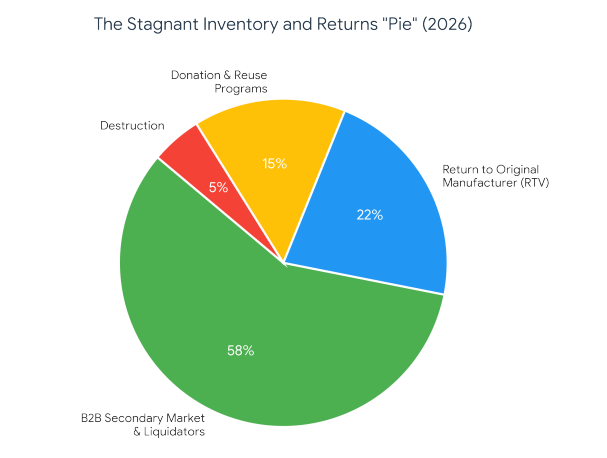
As you can overwhelmingly see, the largest portion of this immense financial pie (58%) goes to companies like ours. Corporations trust the secondary market because we are the only ones with the logistical capacity to absorb their volume and save their turnover metrics. That 58% represents billions of dollars in designer clothing, electronics, toys, and home goods that are ready to travel to your business.
4. Transform Corporate Strategy into Your Own Success (Local Hyper-Turnover)
Now that you understand why major brands need to liquidate, let’s talk about what is most important: how this multiplies the money in your bank account.
The liquidation model doesn’t just solve the turnover problem for companies in the United States; it is designed to create hyper-turnover in your own business.
By stocking up with Go Liquidator pallets, you acquire a commercial “superpower” that traditional sellers simply do not have:
- Laughable Acquisition Costs: You buy international brands for pennies on the dollar.
- Irresistible Selling Prices: Because your base cost is so low, you can offer your local customers a 40%, 50%, or even 60% discount compared to mall prices.
- Extreme Selling Speed (Your own turnover): An incredible price for a high-quality product creates a sense of urgency in the consumer. That branded blender or premium jacket won’t last weeks in your store; they will sell in a matter of days or hours.
This is the magic of the business. By buying liquidations, you are achieving exactly what the giants seek: sell fast, recover your money, and reinvest. You are turning your business into a constant liquidity machine. Instead of making a little money slowly, you earn excellent margins at breakneck speed.
To achieve this extreme turnover in your country, you need to understand what the modern consumer is looking for: The “buy now, return later” phenomenon and Its Extraordinary Impact on Your Inventory
5. Pallet Diversity: The Secret to Never Stagnating
One last secret about the relationship between liquidations and inventory turnover is the very nature of our pallets.
If you import traditionally from Asia, you generally have to buy hundreds of units of the same product (e.g., 500 identical headphones of the same color). The risk of that single product going out of style and stagnating is extremely high.
In contrast, Go Liquidator’s E-commerce Returns and mixed surplus pallets are a treasure trove of variety. By coming assorted with multiple categories, colors, sizes, and brands, your risk of stagnation is reduced to zero. If your customer doesn’t like the red sweater, they will fall in love with the sneakers that came in the same box. This natural variety acts as a magnet for your customers, who will visit your store repeatedly because they know you will always have “new and surprising merchandise.” Variety feeds curiosity, and curiosity accelerates your turnover.
Your Moment to Accelerate Full Throttle
Global trade is a perfect ecosystem. What represents a stagnation and turnover problem for a corporation in New York or Los Angeles is the raw material for your financial prosperity in Colombia, Mexico, Chile, or Peru.
Major brands need to free up space; you need high-profit premium products to make your market fall in love. At Go Liquidator, we are the bridge that unites these two immense needs. We have consolidated relationships with the most prestigious chains in the United States to ensure that merchandise flows into our Miami warehouses, ready to be dispatched to your door.
Are you ready to inject extreme speed into your business finances? Don’t let your company’s capital fall asleep on slow shelves.
Take action and contact our team of sales representatives via WhatsApp. Ask them about this week’s highest turnover pallets and let us help you select the inventory that will disappear quickly from your hands.
Sources: Gartner. (2026). | National Retail Federation (NRF). (2026). | Reverse Logistics Association (RLA). (2026).
Frequently Asked Questions
How does retail inventory turnover create opportunities for liquidation buyers?
As major retailers continuously refresh their product selection, they liquidate overstock and returned merchandise to free up warehouse space and recover capital. This steady flow of inventory gives resellers regular access to branded products at prices well below traditional wholesale costs.
How can resellers use inventory turnover to increase profitability?
Resellers can maximize profits by understanding retail inventory cycles, purchasing liquidation lots when inventory turnover is highest, and stocking products before peak demand periods. Aligning sourcing strategies with retailers' inventory management practices helps secure better deals and improve resale margins.
